
…. No, I Don’t Make Crappy Desserts (or vegan desserts, for that matter)
“You’re lactose intolerant?! How are your desserts any good if you can’t eat them?”
My job interview ended abruptly, yet again. Discouraged and disheartened, I’ve kept my condition under wraps for years. But worn down by a parade of cheesy, creamy family meals that resigned me to eating crackers for dinner, and the paradox of my dietary regimen and chosen métier was questioned again: “Exactly, how are you a pastry chef and you can’t eat dairy?” Let me explain.
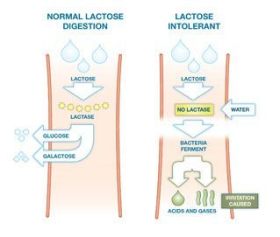 Lactose intolerance occurs when the small intestine doesn’t produce enough lactase enzyme to digest lactose, the sugar that occurs naturally in milk. Few people are born lactose intolerant and most people will lose the ability to digest lactose as they grow older. Even so, degrees of lactose intolerance vary. Some people can tolerate eating a bowl of ice cream but for others, drinking a glass of milk will cause gas, bloating, or diarrhea within minutes. Thank goodness for some mercy, my tolerance hovers between both categories, a quasi-permanent state of dairy purgatory that I learned of by chance.
While I was studying nutrition at Cornell University, it seemed silly to plan a career of dispensing nutritional advice that I didn’t follow so my days began with a regimen of two-mile runs and breakfast of fresh fruit, cereal and milk. I ran all right, back to my dormitory where I promptly lost my breakfast and the first hour of class. I had been drinking milk all my life so it was a few weeks before I nailed it down as the culprit. Milk was out. But it was hard to let go.
During those pre-Lactaid® days, when I wanted to drink milk, I bought the lactase enzyme, cultured enough milk to last a few days, and waited 24-48 hours. Where eating is concerned, patience is not my strongest virtue so I learned to love soymilk[1]. In the meantime, I meandered through the savory side of the kitchen before ditching the pursuit of my nutrition degree and settling into a life of pastry. Back then, restaurants in the college town of Ithaca, New York were far and few between. Even fewer were restaurants staffed with trained pastry chefs. Dessert menus featured pastries from the local bakeries and classical French desserts that anyone could prepare using popular cooking tomes: soufflés, tarte tatin, crème brûlée, chocolate mousse and such.
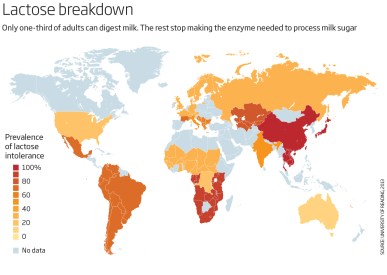
Most of the world’s inhabitants are lactose intolerant to some degree.
As professional pastry chefs like Claudia Fleming, Lincoln Carson, Deborah Racicot, François Payard, En-Ming Hsu, and Ron Paprocki became prominent fixtures on the dining scene, expectations of “dessert” favored artfully decorated tarts, elaborate entremets, and deconstructed compositions. Moving into the role of pastry chef also required more maneuvering as I became more sensitive to milk[2].
Praise the pundits of progress-lactase pills now come in vanilla flavor!
I avoided milk outside of the kitchen, instead saving my “dairy points” for tasting mise en place and finished desserts. “Dairy points”. That’s my informal system of tracking my daily dairy intake. It’s like Weight Watchers for the lactose intolerant. My basic strategy is snacking on high-fiber and fermented food to reduce the digestive stress of eating the parse bites of dairy that I can enjoy with meals: bananas and toasted multigrain sourdough, Greek yogurt and granola (made with olive oil, of course) or whole wheat crackers and cheese. Fermentation degrades lactose so fermented foods, such as Greek yogurt, aged cheese, buttermilk and cultured butter are safe bets. Not so safe are processed foods, from salad dressings to breakfast cereals, as they contain milk and milk derivatives like casein, milk solids, whey powder, and sodium caseinate. Lactase pills are an option but they don’t work if food is digested before the pills dissolve. In other words, if I don’t time the pills to coincide with the meal, I waste $1.00 on two pills and still run the Toilet Olympics. Pointless.
-
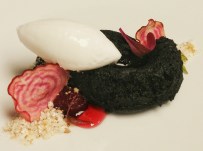
Black Cocoa and Beet Cake with Coconut Sorbet, Beet Puree, and Rose Syrup: flexed my creative muscles to create a vegan dessert that was more than an artfully arranged pile of “fruit and fake cream”.
For some pastry chefs, lactose intolerance becomes their raison d’etre and they channel their creativity into dairy-free desserts. Replacing cream with water-based infusions in ganache, lightening mousses with a blend of Italian meringue and whipped cream, and using olive and nut oils in sponge cakes are some of the techniques I’ve explored in learning to rely less on cream for flavor. It’s an approach that makes sense as dairy mutes the flavors of fruit and chocolate. As a rule though, I won’t impose my dietary regimen on a menu because my perspective of why we cook boils down to a simple mantra: we cook for others. As chefs, our personal tastes should not matter. But more importantly:
“Being lactose intolerant has not deadened my taste buds.”

-
My perfect dessert.
I love {the versatility of} milk. Take browned butter for example. It’s my dirty little secret. I use it in everything: caramel, blondies, brownies, toffee, semifreddo, ice cream and even sorbet. Whipped cream is a marvel of nature, as ethereally light as it is luxuriously rich. Soy milk and coconut milk and all those tubs of sad, gritty, I-wish-I-was-ice cream food substitutes do not compare to a gloriously rich and decadent ice cream made with milk. I often joke that when people eat my ice cream, they taste my tears of desperation because I make my ice cream so delicious that it is worth the discomfort to eat a bowl of it[3]. So good, it hurts. That’s my motto.
So, the next time you meet pastry chefs who are lactose intolerant but are cooking food that they can never eat, admire them. They’re cooking for their guests, and not for themselves. Hospitality at its finest.
 Buttery. Salted. Caramel.
i just came across your blog and it is so awesome to find articles with so much personality and pasion within. Thank you for sharing your knowledge and your unconventional findings in the world of pastry, and also for being so brutally honest, i mean, not even vegans like vegan food haha!
by the way your motto and your food filosophy are amazing af.
Humbled. Thank you!
Oh man, I sympathize with you. Or ´perhaps commiserate is the word. I have been lactose intolerant since the early 80s, yet I incorporate my special lactose-free ingredients in most of my recipes. It’s hard to believe how insensitive and uneducated many people are regarding LI and cooking – some thinking it will be bland, or awful. My wife’s advise? “Don’t tell them it’s lactose free!”