
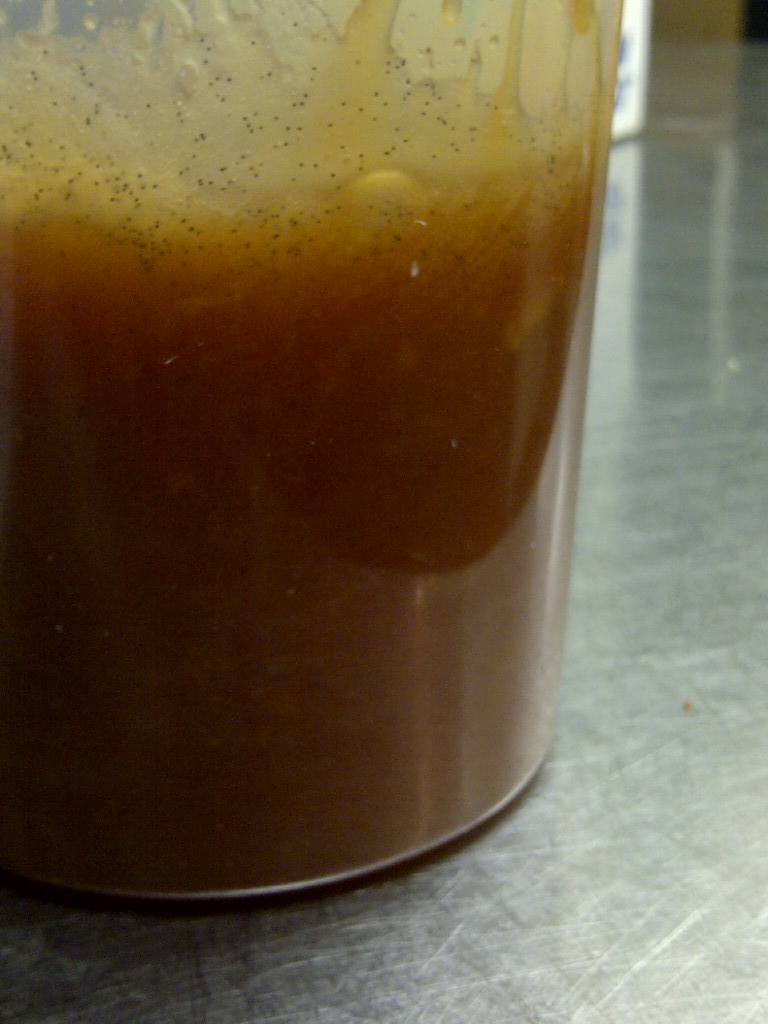
For anyone who’s made ricotta or Greek yogurt, you know that the process yields a lot of whey. At least half of the milk separates into whey that is usually poured down the sink because, well, what can you cook with it? Enterprising chefs have found many uses for whey, ranging from broths to meat marinades, but what’s a pastry chef to do? Of course, I was intrigued when Rebecca Masson, pastry chef and owner of Fluff Bake Bar, posted a picture of macarons filled with a caramelized whey-lavender infused ganache and after several late-night Twitter exchanges, I embarked on exploring the technique.
I can’t be certain but this technique of caramelizing whey for desserts may be an offshoot of mysost (or brunost), a Norwegian whey cheese made by boiling milk, cream, and whey over several hours until it browns and takes on a sweet taste. There are two kinds of fresh whey that result from culturing dairy: sweet whey (from cultured dairy or cheese curdled with rennet) and acid whey (from cheese curdled with additional acids like lemon juice, vinegar, or citric acid). In Milk: The Surprising Story of Milk Through The Ages, food historian Anne Mendelson elaborates that all of the lactose, the sugar that gives milk its sweet taste, is contained in the whey and allows whey to take on a caramel flavor and fudgy consistency when cooked for several hours.
Although whey can be caramelized simply by cooking over low heat for several hours and stirring occasionally, the high concentration of lactose promotes a grainy texture, akin to ice cream that’s been thawed and re-frozen one too many times. Adding sugar prevents the lactose from creating a grainy texture but the constant stirring introduces the possibility that the sugar will crystallize as the water evaporates. Since adding an acid to a sugar solution prevents it from crystallizing, I recommend that you add some lemon juice if you are caramelizing sweet whey to avoid the sugar from crystallizing. Most of the whey I caramelized was acid whey, a result of ricotta and mascarpone cheesemaking, so I did not add any additional acid.
In spite of the long cooking time, the caramelized whey did not taste like “cooked milk”. At first lick, the caramelized whey tasted a bit salty, then hit a crescendo of sweet, and finished with a yogurt-like tang. Overall, the caramelized whey tasted like a lighter, cleaner version of dulce de leche that would pair well with chocolate desserts that feel too rich and cloying when eaten with traditional caramel.

Caramelized Whey
Yield: 3 quarts of whey will yield 2 pints of caramelized whey
1500 grams fresh whey
500 grams granulated sugar
1 vanilla bean (seeds only)
20 grams lemon juice (if using sweet whey)
150 grams glucose (optional)
Reduce whey over medium heat to 1,000 grams. Add sugar, vanilla bean seeds, and glucose or lemon juice (if using). Reduce heat and simmer, stirring occasionally, until the whey has caramelized and reduced to a syrupy consistency. Be patient. This will take a few hours. Once the whey begins to foam, it will caramelize quickly and should be stirred more often. The caramelized whey thickens considerably when cooled.
NOTES:
- Use fresh whey (the liquid that remains after making cheese or culturing Greek yogurt). Do not reconstitute the whey powder sold in health food stores.
- Glucose will prevent the whey from crystallizing as it caramelizes and adds an elastic consistency that allows the caramelized whey to be used as is for a bonbon filling or ice cream swirl.
- The whey can actually be caramelized without sugar but its high concentration of lactose makes it prone to forming a grainy texture once the whey caramelizes. Even if you are caramelizing the whey for savory applications, I would recommend replacing the sugar with glucose.
 Buttery. Salted. Caramel.
Did this recipe but only with using the whey and surgar. Reduced quarter of the way, then added sugar. Cooked down for about 4 hours. Got a dark brown color .
End result: loved it. great tangy, nutty flavor without being too sweet. Keeping this one! Thanks!
I know this post is old, but I love it. I was researching recipes for leftover whey and found your blog.
Oldie, but goodie. Glad you found it helpful. Thank you!
So you think you could make this in a pressure cooker to cut down on time? I know you can make dulce de leche in a pressure cooker.
How long will this last in the fridge? Can’t wait to try it!
The longest I’ve kept it was a couple of months and that’s only because I work in a kitchen so I needed to use it. It may caramelize if it sits for a while but you can add a splash if water and boil to dissolve the crystals.
Could I use a sugar substitute like stevia, munkfruit, Xylitol or erythritol or is the chemical makeup of sugar that is needed here?
Most of the substitutes you mentioned (ending in -ol) are sugar alcohols and will not brown or caramelize when heated. Stevia also does not caramelize. You may have luck with monk fruit but it will contain impurities (relative to pure cane sugar) that may cause the whey to form a scum and boil over.
I have used the sugar substitute allulose successfully in this recipe.