
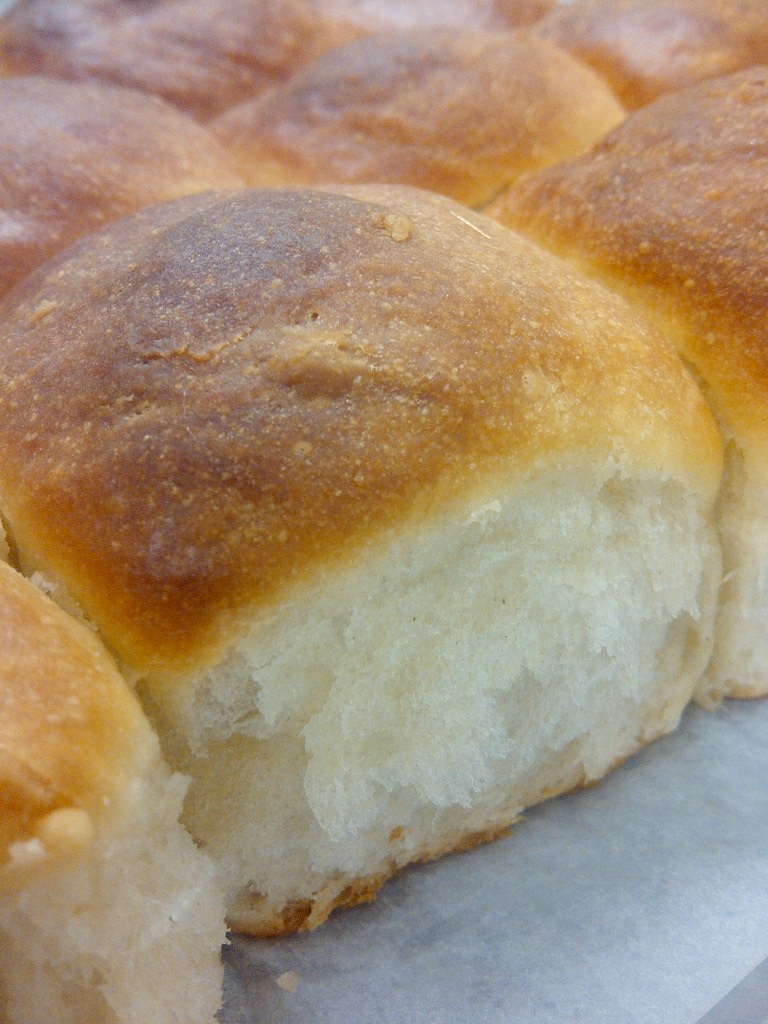
Parker House rolls are a traditional American bread that was developed at Boston’s Parker House Hotel (now the Omni Parker House) during the 1870s. As the hotel never bothered to trademark the recipe or the name, the roll has become the standard bearer for soft dinner rolls with international cooking tomes and American bakeries boasting their own versions. Buttery, soft, and slightly sweet, the Parker House roll is the antithesis to the crusty, chewy Old World, European-style breads that were popular during the late 1800s. (I would also argue that the Parker House roll is the predecessor to the unfortunate American classic that is Wonder Bread. But this is another essay for another day…)
This is not the kind of bread I bake regularly except that I have to make a batch of these rolls daily for one of the restaurants where I work. I prefer my bread crusty, chewy, and malty sweet and this bread is a little too soft and doughy for my taste. However, a light toasting and a side of jam and sweet cream butter makes this roll perfectly acceptable to serve with a cup of coffee for a light afternoon snack, a tradition that I indulge in daily between 2 and 4pm in lieu of lunch.
Traditionally, Parker House rolls are shaped by flattening the center of a ball of dough with a rolling pin and folding the oval shaped roll in half. The unusual shape owes its existence to some mythical legend that an angry pastry chef threw unfinished rolls into the oven resulting in their dented appearance. Having spent almost two decades in professional kitchens, this legend sounds about right. Even so, I just place the rolls side-by-side to create a pull-apart effect—and it doesn’t make the roll any less delicious. (Just ask “The Roll Thief”, one of the cooks who always pilfers a roll or two before I have a chance to pack them for service.)
Parker House Rolls (Professional Recipe)
Yield: eighty 2 ¼ ounce rolls
I researched many variations on this recipe: some leavened with baking soda, baking powder, and yeast; others dunked in butter before shaping and baking, others enriched with instant potato flakes (yes, please!!). In the end, I decided that all these extra steps and ingredients were not worth the effort or the expense. Ideally, I would use buttermilk for this dough as its acidity tenderizes biscuits, cakes, and pastry doughs. But as true buttermilk is a rarity these days, a combination of water and yogurt will work just as well.
2 lbs. 8oz. water, cool
3 eggs
1 lb. yogurt (or crème fraiche)
1 oz. instant yeast
5.5 lbs. all-purpose flour (organic and unbleached)
11.5 oz. sugar
2 oz. salt
16 oz. butter, chilled but pliable
melted butter, as needed
Parker House Rolls (Home Recipe)
Yield: twenty 2 ¼ ounce rolls)
7 oz. water, cool
1 egg
6 oz. yogurt
0.25 oz. instant yeast
1.45 lbs. all-purpose flour (organic and unbleached)
4 oz. granulated sugar
1/2 oz. salt
4 oz. butter, chilled but pliable
melted butter, as needed

Place all ingredients, except butter, and mix on low speed using the dough hook until a dough forms and gluten is well-developed, about 10-15 minutes. Add butter and mix on medium speed for 2 minutes. The dough will be slightly tacky. Place the dough in a greased- 4 gallon container ( or a large stainless steel bowl if you are making the small-scale recipe), cover, and refrigerate for one hour. Remove the dough from the refrigerator, punch down, fold over and flip so that the center of the dough is now on the outside. (At this point, the dough can be chilled overnight.) Refrigerate the dough for another hour.
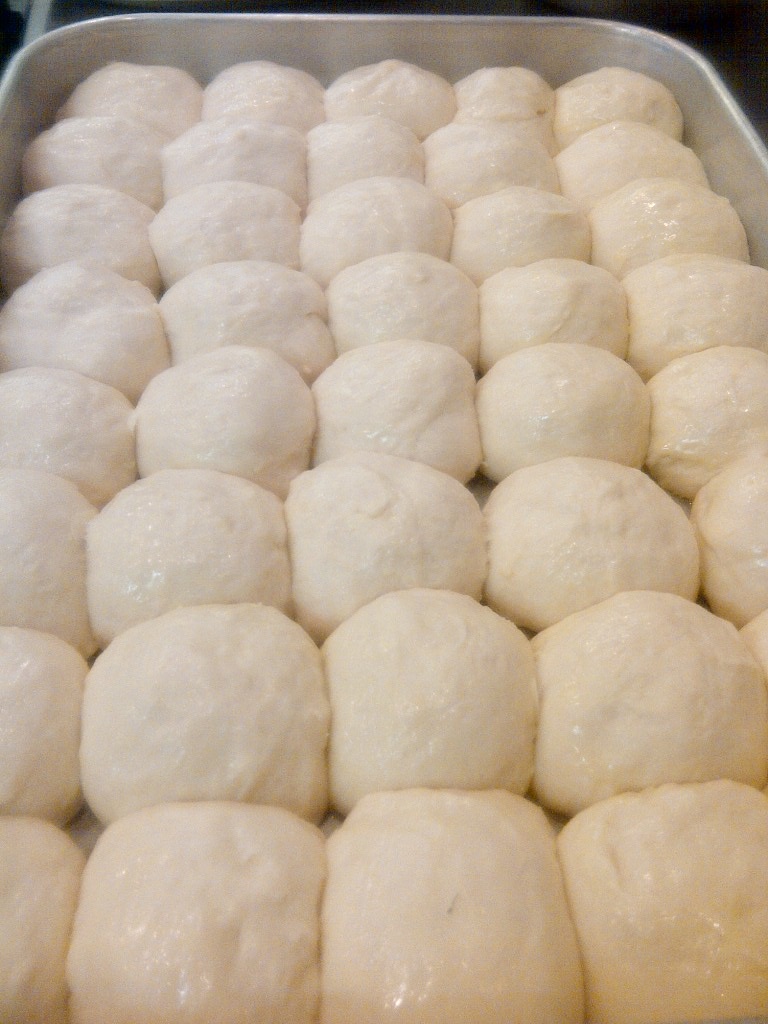
Once the dough is well chilled, portion into 2 ¼ ounce pieces, roll into balls, and place into pan that has been greased with melted butter. Leave up to a half-inch space between each roll. Brush the rolls with melted butter and proof until the dough has almost doubled in size. Aside from the mixing, this is the most important part of the recipe because it creates the rolls’ distinctively feathery lightness. Bake at 350 degrees Fahrenheit for 30 minutes or until the rolls are a deep golden brown. Brush the baked rolls with (more!) melted butter and cool for fifteen minutes before unmolding and enjoying with (even more!) butter.
NOTES for SUCCESS:
- All of the Parker House recipes that I’ve read instruct you to combine all the ingredients and mix to form a dough but I found the finished roll was too cakey and pasty. As I like a slight chew to my dough, I prefer to mix all the ingredients except the butter until the gluten is well-developed and add the butter towards the end of the mixing cycle.
- Do not use warm water as the dough will become so soft and sticky after mixing that it will be unworkable.
- As this dough is enriched with sugar, eggs, and butter, most of the resting time is intended to chill the dough to make it easier to handle and not to develop flavor.
- After the dough is shaped, be sure to proof it thoroughly so the finished roll will feel light but taste rich and buttery.
- I modified the small-scale recipe because it’s more convenient to use a whole egg (instead of three-quarters of one) and to use one container of yogurt instead of wondering what to do with the other two ounces.
 Buttery. Salted. Caramel.
must definitely give this a try!