
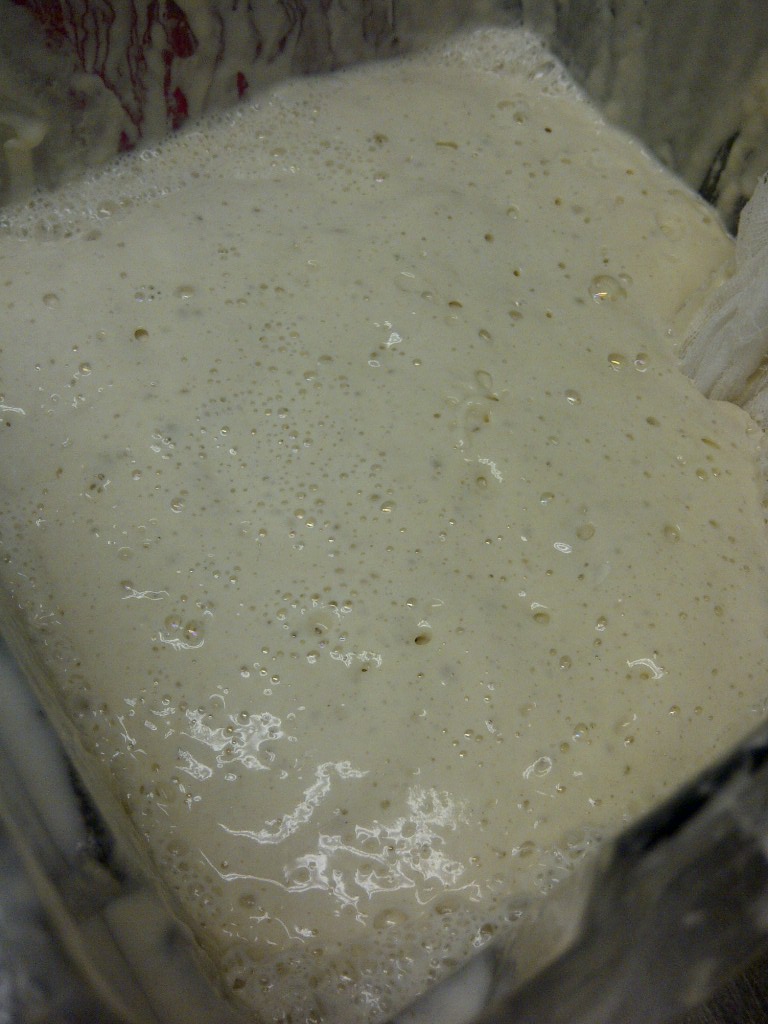
Sourdough starters are unparalleled in their ability to coax flavor from flour. Even if you don’t make bread regularly, sourdough starters can be used in cakes, beignets and even bread pudding. No pastry kitchen should be without a sourdough starter and you can start one in less than two weeks. Once you’ve created your starter, all you need to do is feed it regularly to keep it active:.
To create your starter, begin with:
200g flour, unbleached and organic (preferably whole rye flour which is rich in sourdough yeast and bacteria)
200g mineral water (you can also use tap water but you will need to let it stand at room temperature for at least 12 hours to allow the chlorine to evaporate)
150 g grapes, optional (this will increase your chances of capturing wild yeast)
Rinse grapes, air dry, and tie in cheesecloth. Mix flour and water. Mash the grapes with your bare hands and suspend the grapes in starter. Cover and ferment at room temperature until bubbly. This will take a few days and the starter will puff up slightly. Once bubbly, it’s time to feed your burgeoning starter:
Stir in:
200 g bread flour, unbleached and organic
200 g water
Let the starter continue to ferment for another day after which it will rise quickly and will be ready to convert to a stiff starter. A stiff starter will ferment slowly which allows the flavor to develop and only needs to be fed once daily.
First, discard the grapes and stir together:
120g sourdough starter (the rest can be “discarded” into bread dough that you are already baking)
120 g water
Knead in to form a soft dough:
120 g bread flour
And ferment for one day.
Refresh the starter with 120g flour and 120 g water daily for another week. Over the course of this week, the starter should rise quicker and smell fragrant. When the leaven starts to sink, it needs to be fed. If at the end of this week, you are not ready to bake with the starter, refrigerate and continue to feed daily. You will need to discard 240 g of starter before feeding in order to prevent your starter from morphing into “The Thing”.
Once you are ready to bake with your starter, remove 100 g of starter and mix with 300 grams water and 500 grams of flour. You may want to play around with the consistency of the starter. For a mild, faster-fermenting starter, add a little more water to the starter; for a sharper, slower-fermenting starter, add a little more flour to the starter. Place the starter in a sealed container to ferment for 8 to 12 hours, or until it has fully risen and deflates when touched. This is the starter that you will be baking with. It is known as a levain, or “fed” starter. The remaining starter is “the mother” or “the chef”. She will need to be kept in the refrigerator and fed at least every other day. Whenever you need to bake, remove a portion of the mother and culture it into a levain.
 Buttery. Salted. Caramel.
Leave a comment