
In the days before chemically manufactured baking soda was available, ash water was used both as a leavener and as a source of potash. It seems odd to us now but using ash made sense as wood-burning ovens and fireplaces were the primary sources of cooking and heating the home. Although potash worked instantly, it was difficult to dissolve and often left discolored streaks in cakes and pastries. The increasing scarcity of wood eventually led to the search for alternate sources of carbonate. Pearlash, when combined with soured milk, produces pockets of carbon dioxide that lighten a batter. Pearlash was only used until the 1840s, when it was replaced by saleratus, and later by baking soda.
Saleratus, an early form of baking soda, worked like potash except that it was easier to use. It could neutralize acidic ingredients like honey, buttermilk, or molasses, or it could be mixed with cream of tartar—itself a byproduct of winemaking—to make an early form of baking powder. Far superior to potash, baking soda released gas quicker and the aftertaste was not as bitter as soda ash and in 1791, Nicolas LeBlanc developed a process to convert salt into soda ash from which baking soda was extracted.
 As baking soda became widely available in the 1830s, bakers began adding sour milk and baking soda to their bread dough to speed up the rising process, a reaction that proved to be especially useful in baking biscuits and breads. Although revolutionary, using sour milk for the acid component of baking powder was unreliable as it was difficult to measure how much baking soda neutralized the varying acidity of sour milk. Replacing sour milk with cream of tartar improved the reliability of the leavening process and the first commercial baking powders appeared in the mid-1850s and were sold as distinct packages of baking soda and calcium acid phosphate.
In spite of this advancement, leavening continued to be a cumbersome process. Bakers still had to combine ingredients to initiate the leavening process and the doughs and batters needed to be baked immediately after mixing and before the baking soda lost its oomph. By the 1860s, Eben Horsford developed a mixed leavening agent marketed as “Horsford’s Yeast Powder”, the name being a clear reference to yeast’s function as a leavener. Manufacturers continued to compete furiously to develop a better product and double-acting baking powders soon appeared on the market around 1890. While these powders continued to use baking soda as the alkaline compound, they also contained other acids that became active once moistened and again during baking. These new blends of baking powder were more stable in the can and allowed the baker more control in the kitchen.
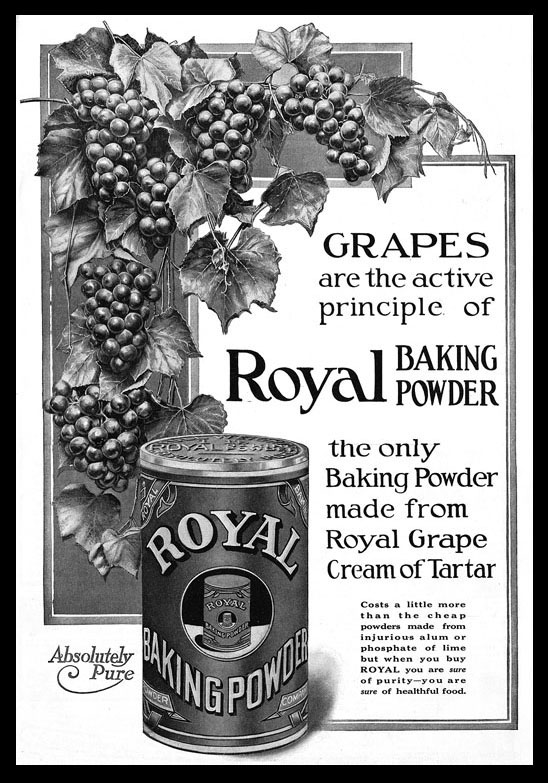 Controversy surrounding the use of chemicals in food is not a new phenomenon and the late 1800s were no exception as the advent of baking powder met with mixed reception among the nation’s cookbook author, some of whom were suspicious of chemicals introduced into food. “We do not approve of the introduction of these substances into cakes,” Eliza Leslie wrote in Miss Leslies New Cookery Book (1857), “They give a sort of factitious lightness very different from that honestly produced by a liberal allowance of egg and butter, genuine yeast, and good beating and stirring—but they destroy the taste of the seasoning, and are certain destruction to the taste of lemon, orange, strawberry, pine-apple, and every kind of fruit flavoring”. On the last point, Ms. Leslie was correct as the extra acidity contributed by the fruit leaves some of the baking powder unconsumed as a lingering soapy aftertaste.
Once alum-based baking powders entered the market, a war began between the makers of tartrate and aluminum phosphate powders. Tartrate manufacturers claimed their baking powder contributed superior flavor and was safe for human consumption which implied an inherent danger in consuming alum powders. As is the case in many of today’s product wars, the motive was profit as tartrate manufacturers strove to eliminate the cheaper competition. After the passing of many years and countless dollars spent, neither side won as both types of baking powder are sold today. The debate continues as many bakers continue to claim that aluminum baking powders leave a metallic aftertaste. Perhaps it is my proclivity for drinking coffee with my biscuits and scones, but I can’t tell the difference.
Part 1: Baking Powder and The Acid-Base Reaction
 Buttery. Salted. Caramel.
Leave a comment